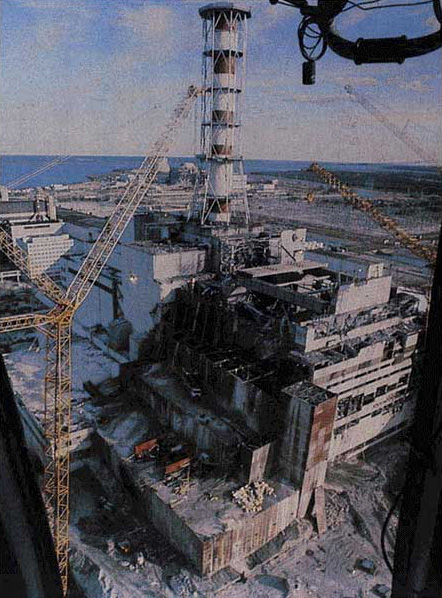
Chernobyl accident
Mikhail Gorbachev
b. 1931
north of the Caucausus in Stavropol
Grandfather sent to Gulag
protected by family during German
occupation
promising/ambitious student
studied law/political theory at
Moscow Univ
marries fellow student Raisa Maximova
became hardworking successful party
official
in charge of agriculture
rose to local party secretary
politically savvy, atuned to the way the
wind was blowing with Stalin, Krushchev, Breshnev,
Attracts attn of party
1978
brought to Moscow as Sec of
Central Ctte
1983
travels to Canada, England
Thatcher describes him as “a
man I could
do business with”
1984
on visit to England, he told Europeans he wanted to work with them to
"build a common European home"
1985 Elected First Party Secretary
looked at the big picture
saw “a new world civilization developing”
moved away from Marxist rhetoric/ideology
Perestroika
economic restructuring
introducing “cost accounting” (!!)
profitability as goal
entrepreneurism/privatization in
agric
Glasnost
"openness"
more media freedom
pluralism within party
"This is why we started everything in the first place
--so a human being can feel normal, can feel good,
in a socialist state. So that he will feel above all like
a human being," (Stokes, 72)
1986
Chernobyl accident
Released of Andrei Sakharov
from exile
Eased censorship in media
Factual reporting allowed
Films critical of Stalin shown
Tourist maps redrawn (accurately!)
Gorbachev
Didn't intend to be the end of the USSR
rather to "complete the creation of a socialist state based on the rule
of law (Stokes, 73)
"if we can bring people back
into the socialist system instead of alienating them, we can give
socialism a second wind," (July 1989, Stokes 75)
1989 competively elected
Congress of People's Deputies
"relaxed" the Breshnev
Doctrine"
i.e., left Erich Honecker holding the bag