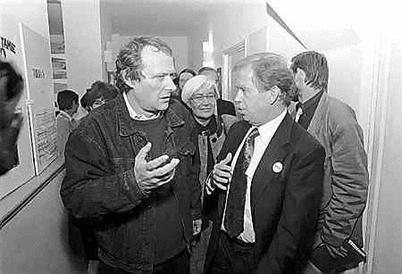
Michnik, Adam
b. 1946; as a 15 year old helped from
“Club of the Seekers of Contradiction” radical study group
member of Kuron’s Young Walterites
founding member of KOR
today executive editor, Gazeta Wyborcza
(begun to help inform voters for first
semi-free elections negotiated at the Round Table)
“The New Evolutionism”
Argues that neither revolution nor reform possible
Revolution would invite Soviet invasion which would be a national massacre for the Poles
Instead, need to work within the framework
of the Breshnev doctrine
Polish society as “post-totalitarian” and “post-ideological” because Marxist-Leninist doctrine “is a dead creature, an empty gesture, an official ritual. It no longer stimulates discussion or fires up emotions. It is incapable of causing internal tension and division (146).”
Therefore, reform/revisionism also not viable
and senseless to wait for “the Polish Dubcek”
(144) I believe that what sets today’s opposition apart from (earlier oppositional movements) is the belief that a program for evolution ought to be addressed to an independent public, not to totalitarian power. Such a program should give directives to the people on how to behave, not to the powers on how to reform themselves. Nothing instructs the authorities better than pressure from below.”
**(147) job of the intelligenstia to formulate
alternative programs and defend the basic principles
** also recognizes need for cross class
alliance
when he says intelligentsia must converge
their activities with those of the working class
[[comment here on class in socialist societies]]
voices, albeit weak, are nonetheless authentic: they form an independent public opinion, with nonconformist attitudes and oppositional thought.
**need to “live in dignity” in Kolakowski’s words
not striving for better tomorrow but rather a better today (148)
This point is mirrored in Havel’s “Power and the Powerless” where he argues that it is pointless to have a particular political program in mind
**the goal is not parliamentary democracy or to have an opposition party
**Existential movement is the goal
real life, moral and ethical life
authentic community based on small groups wher you can trust, discuss, live ethically
***NOT possible in Western democracy either
Havel’s is a much more damning criticism of modernity itself
in fact, this is a major theme of his plays
1963 - The Garden Party
absurdist, satirical examination of bureaucratic
routines and their dehumanizing effects.
1965 - The Memorandum
an incomprehensible artificial language
is imposed on a large bureaucratic enterprise, causing the breakdown of
human relationships and their replacement by unscrupulous struggles for
power.
In these and subsequent works Havel explored
the self-deluding rationalizations and moral
compromises that characterize life under
a totalitarian political system
but also a critique of bureaucratic, automatism that permeates Western democracies as well
IN this Havel brings us full circle to the beginnings of communism as a quest for modernity
Communism/parliamentary existence a facile distinction covering up the commonalities of modern, bureaucratic life
(Weber on forms of authority-traditional, charismatic, rational-bureaucratic)
Ortega y Gassett – mass society
Havel, Vaclav
b. Oct. 5, 1936, Prague, Czechoslovakia
playwright, poet, and political dissident
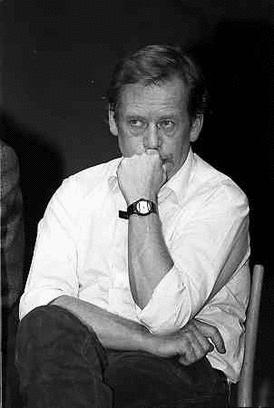
son of a wealthy restaurateur whose property was confiscated by the communist government in 1948
as son of bourgeois parents, Havel
was denied easy access to education but
managed to finish high school and study on the
university level (but didn’t finish degree?)
1959 stagehand/playwright in a Prague theatrical
company
began writing plays and by 1968 had progressed
to the position of resident playwright of the Theatre of the Balustrade
company.
prominent participant in the liberal reforms of 1968 (Prague Spring) so his plays were banned and his passport was confiscated after Soviet invasion.
‘70s and '80s he was repeatedly arrested
and served four years in prison (1979–83)
Charter 77 signatory and theorist
Forms the Civic Forum, coalition of noncommunist opposition groups, in ‘89
In early December the Communist Party capitulated and formed a coalition government with the Civic Forum.
“Velvet Revolution”
Elected to the post of interim president
of Czechoslovakia on December 29, 1989, reelected to the presidency in
July 1990,
Havel, opposed the division of Czechoslovakia.
resigned from office. 1991 he was elected president of the
new Czech Republic. re-elected
by a narrow margin in 1998.